A General Counsel's diligence load in 2026 is heavier than the headcount supporting it. Deal volume has recovered, enforcement has sharpened, and boards expect in-house legal to flag material risk before outside counsel has to. The filings that hold the answers are public, they live on SEDAR+. The work of reading them is not. This blog is for the in-house GC running M&A diligence, vendor onboarding, and litigation-risk review without a research bench behind them. It covers what due diligence on SEDAR+ looks like, where the platform stops being enough, and what AI on top of it now changes.
Most diligence questions a GC fields can be answered, at least in part, from the public record. A few examples:
A clean diligence memo answers each of these with citations, runs across multiple years, and reconciles inconsistencies between sections. None of this is unreasonable. All of it is time-consuming when done by hand.
SEDAR+ is the canonical filing repository for Canadian capital markets. It is the source of truth and there is no working around it. But for a GC actually running diligence, the limits show up quickly.
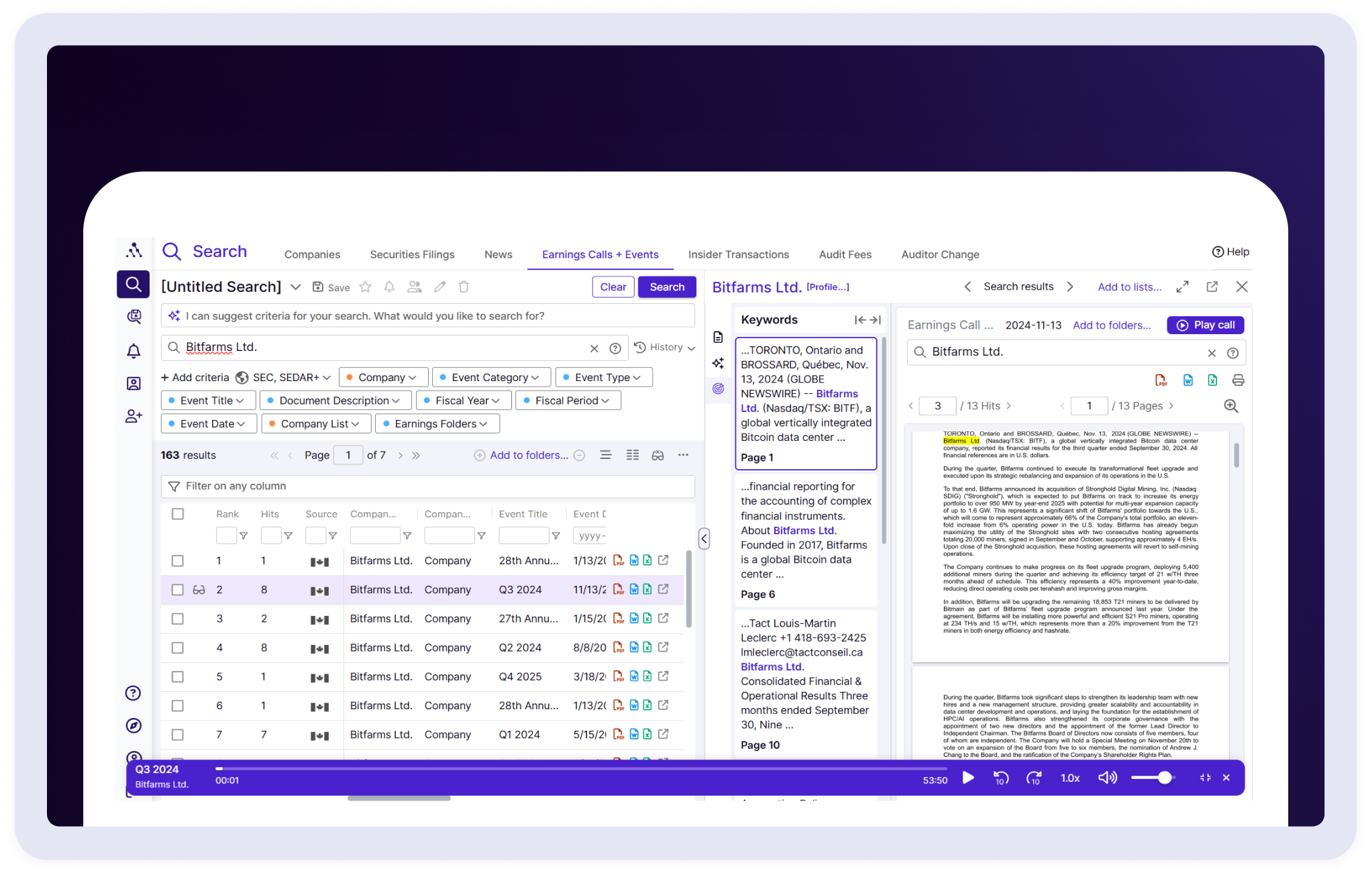
SEDAR+ is a filing surface, not a research tool. Documents come down as PDFs. Search across the corpus is basic. There is no Q&A across filings, no cross-section reconciliation, no peer benchmarking, no structured export. A GC who needs to read every public filing for a target, across five years, three jurisdictions if the issuer is interlisted, and dozens of document types, is doing it the way researchers did in 2010. SEDAR+ is also Canada-only. The moment a target has US-listed securities or a US subsidiary, the diligence flow switches to EDGAR and back, and the GC is the one stitching the picture together. And SEDAR+ does not flag what does not fit. If the AIF says one thing about revenue concentration and the MD&A says another, the platform hands you both PDFs. It will not tell you they disagree.
The shift in 2026 is that the reading is being done by a system that cites every claim back to the page it came from. The GC reviews, refines, and signs off — but does not have to read 2,000 pages of disclosure to find the three that matter. A few workflows where this is now real:
Cross-jurisdictional diligence. For an interlisted issuer, the same query runs across SEDAR+ and SEC filings in one pass. The 10-K language is compared against the AIF; the proxy statement is read alongside the information circular; insider activity on SEDI is reconciled with Form 4 filings. The GC sees one picture, not two.
Continuous-disclosure monitoring. Once a deal closes, the new subsidiary's filing obligations roll up to the parent. Customizable alerts notify the GC when a new filing lands, when filing cadence slips, when an auditor change is filed, or when SEDI activity crosses a threshold. The same alerts can be shared with outside counsel and audit committee members without leaving the platform.
Litigation and enforcement risk. Historical filings, material change reports, and enforcement-action references can be queried as a single corpus. A GC building a litigation hold or responding to a regulator can pull the evidence and cite it in the same step.
Clause and policy comparison. Executive employment agreements, indemnification clauses, change-of-control provisions, and governance policies can be compared across the peer set.
Avantis is a verifiable, audit-grade AI research platform built for the people who cannot afford to be wrong. For GCs specifically, three platform capabilities carry the weight:
1. The corpus is broad and bilingual. 50M+ documents across SEDAR+ and SEC, English and French, with SEDI insider transactions indexed alongside the issuer record. Cross-jurisdictional diligence runs in a single query.
2. Every answer is cited. Q&A on SEDAR+ and SEC filings returns the source page for every claim. Work product is review-ready and defensible, important when a board or a regulator asks where a number came from.
3. Monitoring is built in. A customizable alert dashboard tracks new filings and insider activity for the target, the peer set, or the GC's own issuer. Alerts can be shared with team members and external partners.
The Q&A, benchmarking, alerting, and structured Word, Excel, and PDF export capabilities described above are what the platform delivers in market today. A diligence memo a GC will sign has to be cited, traceable, and defensible. That is the standard the work has always met by hand, and the standard AI on top of SEDAR+ has to meet to be worth using. In 2026, it can.

Ready to optimize your market research process?
Contact Avantis today for a personalized overview and free trial.

 Get Started with Avantis for Free
88 Queens Quay West, Suite 2500, Toronto, ON, Canada M5J 0B8

(289) 803-8222
© 2026 Avantis AI Inc.