Canada’s mining sector has long been a cornerstone of the national economy, supplying critical minerals that power everything from construction to clean energy technologies. At the center of major resource development decisions sits the Major Projects Management Office (MPMO), a federal body designed to streamline regulatory processes for large-scale natural resource projects. Understanding how mining intersects with the MPMO offers a window into Canada’s broader strategy for balancing economic growth, environmental stewardship, and Indigenous engagement.
The MPMO was established to improve the efficiency and transparency of federal regulatory reviews for large resource projects, including mines, pipelines, and energy infrastructure. Rather than replacing regulatory agencies, it coordinates them, bringing together departments like Natural Resources Canada, Impact Assessment Agency of Canada, Fisheries and Oceans, and Environment and Climate Change Canada.
For mining companies, this coordination is critical. Large mining projects often trigger multiple federal and provincial approvals, each with its own timelines and requirements. The MPMO acts as a central hub, helping proponents navigate the system while ensuring accountability across departments.
Mining is not just another industry in Canada, it is a strategic asset. The country is one of the world’s leading producers of key minerals such as nickel, copper, potash, and uranium. More recently, Canada has positioned itself as a leader in critical minerals essential for batteries, electric vehicles, and renewable energy systems.
This shift has increased the importance of the MPMO. Projects tied to lithium, cobalt, and rare earth elements are now viewed through both an economic and geopolitical lens. Governments are under pressure to accelerate approvals while maintaining rigorous environmental and social standards.
One of the biggest challenges in mining development is regulatory complexity. Without coordination, projects can face delays that stretch into a decade or more. The MPMO addresses this by:
This approach reduces uncertainty for investors and helps Canada remain competitive globally. However, coordination does not mean deregulation. Projects must still meet strict environmental and consultation requirements.
A defining feature of modern mining policy in Canada is the central role of Indigenous communities. The duty to consult and increasingly, to collaborate has become a core component of project development.
The MPMO plays a supporting role in ensuring that consultation processes are integrated into the regulatory timeline rather than treated as an afterthought. Successful mining projects today often involve:
This shift reflects a broader recognition that long-term project success depends on meaningful partnerships, not just regulatory compliance.
Environmental assessment remains one of the most rigorous aspects of mining approvals in Canada. Projects must evaluate impacts on water, wildlife, air quality, and local ecosystems. Climate considerations are also increasingly central, with proponents expected to demonstrate how their projects align with national emissions targets. The MPMO helps ensure that environmental reviews are conducted efficiently but thoroughly. By coordinating federal agencies, it reduces duplication while maintaining high standards.
Despite its intended benefits, the MPMO is not without criticism. Some stakeholders argue that:
On the other hand, environmental groups sometimes worry that efforts to streamline approvals could weaken oversight. The reality lies somewhere in between: the MPMO is an evolving mechanism, constantly adapting to competing pressures.
Looking ahead, the role of the MPMO is likely to expand as demand for critical minerals grows. Governments are exploring ways to further accelerate project timelines without compromising environmental or social standards. Digital tools and data-driven decision-making are also becoming more important. Platforms that enhance transparency, track regulatory progress, and integrate stakeholder input can significantly improve outcomes.
Organizations like Avantis are part of this transformation, leveraging advanced technology to bring greater clarity and efficiency to complex regulatory and operational environments. As mining projects become more data-intensive, such tools will play an increasingly important role in supporting both industry and government. If you’re still relying on auditors or manual research to draft disclosures, there’s a faster way. Avantis helps reporting teams at public Canadian mining companies streamline disclosure drafting by giving instant access to peer examples across critical filings like MD&A, AIFs, and financial statements.
The platform is especially useful when:
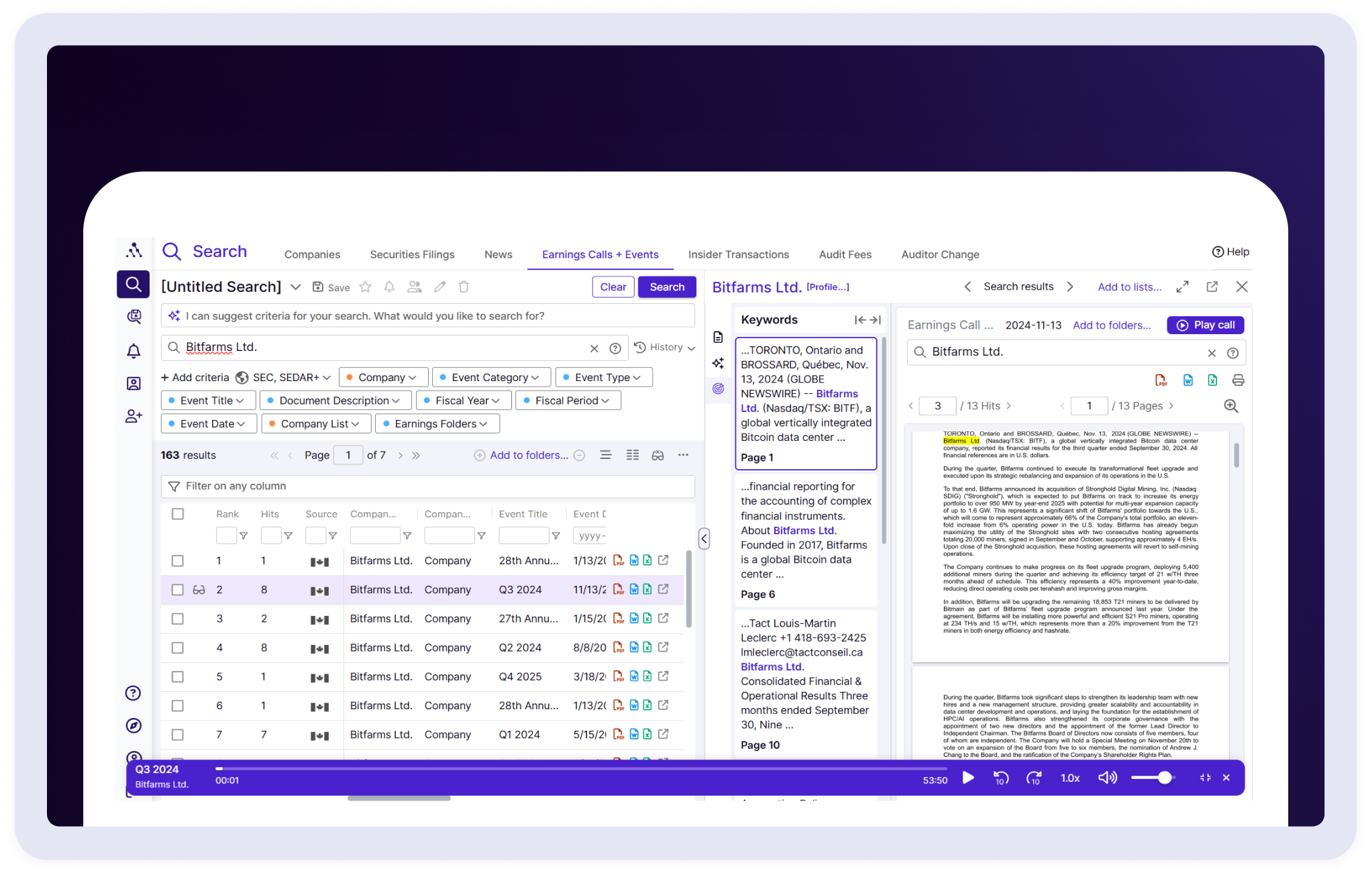
For year-end and quarter-end reporting, having a reliable way to locate all required SEDAR+ disclosures is critical. With Avantis, you can instantly retrieve and filter material contracts, MD&A, proxies, AIFs, and compliance filings, from millions of SEDAR+ documents, without manual digging. Instead of spending hours searching PDFs, use advanced search and customizable filters to zero-in on exactly the filings relevant to your disclosure workflows. Avantis also provides searchable access to thousands of calls and transcripts across companies, sortable by event type and reporting period. Whether preparing notes for disclosure reviews, summarizing executive tone for board reporting, or identifying key themes across earnings calls, users can quickly search spoken content and export relevant excerpts. By combining qualitative insights from conversations with structured financial and reporting data, Avantis helps streamline workflows across investment research, audit preparation, financial reporting, and broader corporate market intelligence.
This kind of visibility is especially valuable in industries like mining, where regulatory oversight, stakeholder engagement, and long project timelines create significant complexity. The intersection of mining and the Major Projects Management Office (MPMO) reflects a broader challenge facing Canada: how to responsibly develop natural resources in a modern environment shaped by environmental expectations, Indigenous consultation, and economic pressures. Canada’s approach, centered on coordination, consultation, and environmental stewardship, aims to balance these competing priorities. Institutions like the MPMO play an important role in aligning government agencies, improving regulatory efficiency, and supporting transparency throughout the project approval process. At the same time, the system continues to face pressure to accelerate timelines while maintaining meaningful consultation and environmental accountability.
As global demand for critical minerals continues to rise, the effectiveness of frameworks like the MPMO will become increasingly important. Striking the right balance between speed, sustainability, and inclusivity will influence not only the success of individual mining projects, but also Canada’s long-term competitiveness in the global resource economy.
1. What does the Major Projects Management Office actually do?
The MPMO coordinates federal departments involved in reviewing large resource projects. It helps streamline timelines, improve transparency, and ensure accountability across agencies without replacing their regulatory authority.
2. Why is mining so important to Canada right now?
Mining is central to Canada’s economy and increasingly vital for supplying critical minerals used in clean energy technologies like batteries and electric vehicles, making it strategically important both economically and geopolitically.
3. Does the MPMO make project approvals faster?
It aims to improve efficiency by coordinating reviews and reducing duplication. While it can shorten timelines, projects still undergo rigorous environmental assessments and Indigenous consultation processes.

Ready to optimize your market research process?
Contact Avantis today for a personalized overview and free trial.

 Get Started with Avantis for Free
88 Queens Quay West, Suite 2500, Toronto, ON, Canada M5J 0B8

(289) 803-8222
© 2026 Avantis AI Inc.