Disclaimer: This content is for informational purposes only and does not constitute investment advice or a recommendation to buy or sell any securities. Please consult a licensed or accredited financial adviser before making any investment decisions.
Canadian investors have never had it easier. Low-cost, broadly diversified exchange-traded funds have pushed mutual fund managers into a corner they can't argue their way out of: 2% management fees are hard to justify when you can own the entire global equity market for 0.20%. Below are five ETFs worth knowing in 2026 — what they hold, what they cost, and who they're right for.
MER: 0.20% | Asset class: 100% global equities
XEQT is the most widely held all-in-one ETF in Canada by assets, and for good reason. One ticker buys exposure to over 8,400 companies across North America, Europe, and Asia-Pacific, roughly 45% US, 25% Canadian, 5% emerging markets and 25% international. It rebalances itself. You do nothing except contribute. Its 0.20% MER places it among the lowest-cost all-equity asset allocation ETFs in Canada. For long-term investors under 45 who want a single-ticker retirement portfolio, XEQT remains one of the clearest starting points.
Best for: Hands-off investors building long-term wealth in a TFSA or RRSP.
MER: 0.22% | Asset class: 100% global equities
VEQT and XEQT are nearly identical products. Vanguard's version holds similar global equity exposure with a slight tilt toward Canadian home bias. The MER is two basis points higher, over 30 years, that difference is negligible. The choice between XEQT and VEQT matters far less than simply making the decision and staying consistent. VEQT posted a 15.72% return over a trailing one-year period and is the right pick if you have a preference for Vanguard's fund architecture or slightly more Canadian equity weight.
Best for: Investors who prefer Vanguard and want an all-equity, globally diversified portfolio.
MER: 0.20% | Asset class: 80% equities / 20% bonds
XGRO carries the same cost as XEQT but adds a 20% fixed-income buffer. The bond allocation won't dramatically smooth returns in a major drawdown, but it takes the edge off. More importantly, it gives investors who know themselves — who know they'll check their portfolio during a crash — a reason not to panic-sell. For investors within 10–15 years of retirement, or anyone who experienced 2020 and made a decision they regret, the ballast in XGRO is genuinely useful.
Best for: Moderate-growth investors and those approaching retirement who want a built-in buffer.
MER: 0.05% | Asset class: Canadian equities
VCN tracks the entire Canadian equity market — large, mid, and small cap — at one of the lowest price points available. Over the past year, VCN delivered a 43.55% return, outpacing XEQT and VEQT by a meaningful margin as Canadian markets rallied, particularly in materials and energy. Investors who already hold a globally diversified product like XEQT but want more deliberate home-country exposure use VCN to tilt toward Canada. It's a single-country bet, not a complete portfolio — but as a building block, it's hard to beat at 0.05%.
Best for: Investors adding Canadian equity weight alongside a global core holding.
MER: 0.09% | Asset class: US large-cap equities
ZSP gives Canadian investors access to the S&P 500 — the 500 largest US companies — through a Canadian-listed fund. The distinction matters: holding ZSP inside a TFSA avoids the 15% US dividend withholding tax that applies to US-listed ETFs like VOO. In an RRSP, the tax treaty eliminates withholding, so either works; in a TFSA, the Canadian wrapper is the right call. US equities have dominated global returns for over a decade. Whether that continues is unknowable. ZSP provides concentrated US exposure for investors who want it, at a cost that's hard to beat.
Best for: Investors seeking direct S&P 500 exposure in a tax-efficient Canadian-listed wrapper.
Choosing an ETF is the easy part. Understanding what's inside it, the underlying holdings, the fund structure, the regulatory filings takes more work than most investors put in. For institutional investors, portfolio managers, and analysts, that reading burden is significant. A single ETF may hold hundreds of issuers, each with annual reports, material change reports, and SEC or SEDAR+ filings that carry meaningful signals: governance changes, restatements, auditor switches, disclosure inconsistencies. Tracking these manually across a portfolio is not practical.
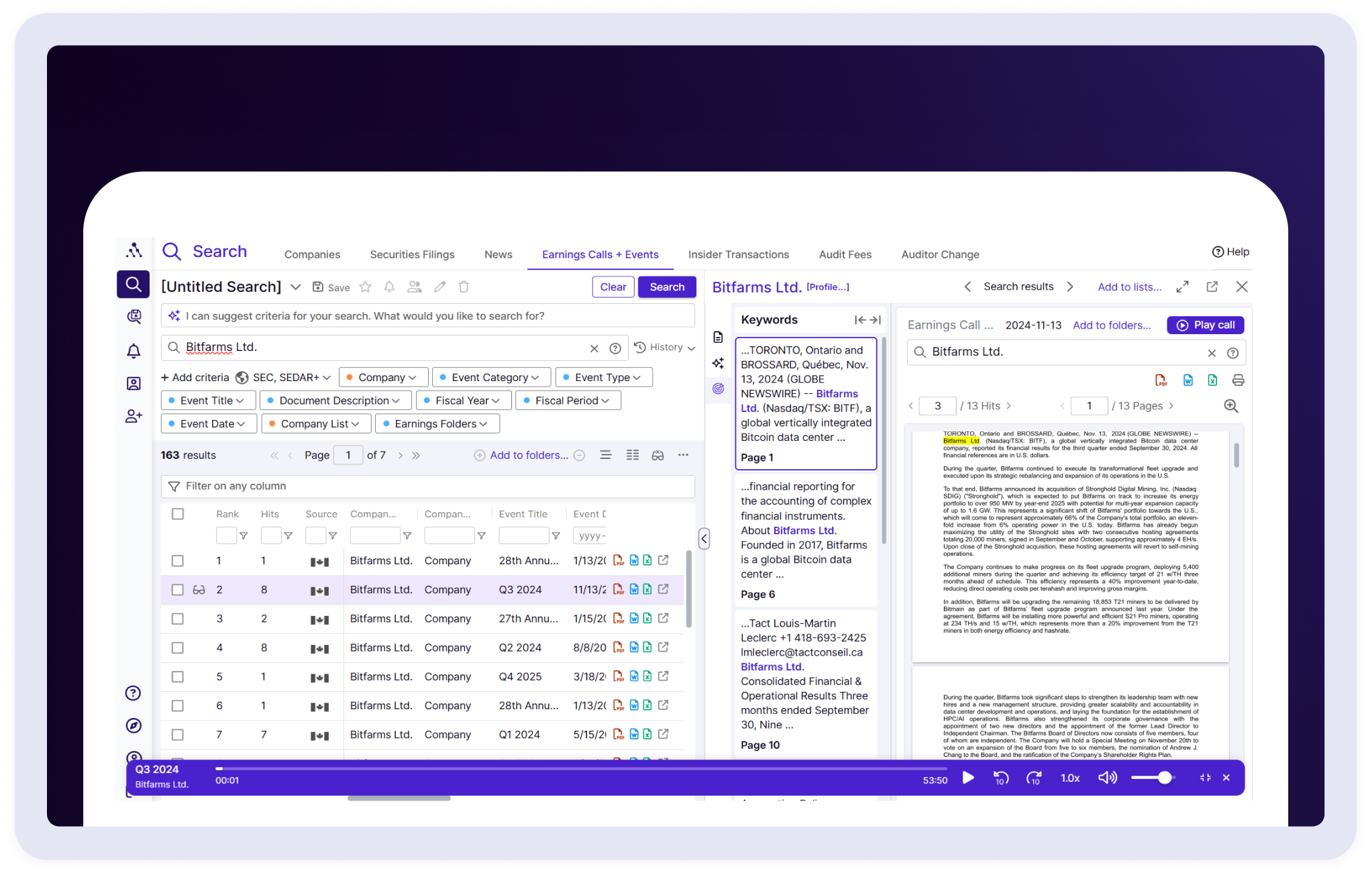
This is the problem Avantis is designed for. The platform today has 50M+ documents across SEDAR+ and SEC. It also boasts several time-saving research features: full-text Boolean search with 100+ filters, structured exports in Word, Excel, and PDF, and real-time alerts to keep you up-to-date on whatever you are tracking.
For analysts and portfolio managers, Avantis AI provides a source-grounded research workflow that automatically links insights back to primary documents. By carrying citations from research through to reporting, it reduces manual verification, increases confidence in conclusions, and helps teams move from question to answer faster. Avantis helps research teams conduct more thorough due diligence in less time, improving both research quality and productivity.
*ETF performance data referenced in this article reflects trailing returns as of mid-2026 and is sourced from publicly available fund data. Past performance is not indicative of future results.

Ready to optimize your market research process?
Contact Avantis today for a personalized overview and free trial.

 Get Started with Avantis for Free
88 Queens Quay West, Suite 2500, Toronto, ON, Canada M5J 0B8

(289) 803-8222
© 2026 Avantis AI Inc.