SEC vs. SEDAR+

Global issuers, cross listed companies, and the advisors who support them live in two parallel disclosure universes: the United States, anchored by the SEC’s EDGAR system, and Canada, where SEDAR+ is the single pane of glass for filings and regulatory information. On the surface both systems let you search, file, and download public disclosures. For legal, compliance, and capital markets teams though, the details are where risk hides. Small structural differences in how EDGAR and SEDAR+ work can change how you manage disclosure controls, prepare deal documents, and monitor market and regulatory signals. This article walks through the practical, not academic, differences between SEC and SEDAR+. Then it shows how a platform like Avantis can turn those differences into an advantage for compliance, legal, and capital markets teams in a way that is value driven, not feature driven.

1. Two systems, two regulatory philosophies

EDGAR (SEC, United States)

EDGAR is the SEC’s electronic system for company, fund, and insider disclosures. It is heavily form driven and designed around detailed US securities law requirements, with long form narratives and structured data like XBRL for financials and certain other disclosures. [SEC]

SEDAR+ (CSA, Canada)

SEDAR+ is the new web based national system that consolidates SEDAR, cease trade order lists, disciplined lists, and other legacy databases into a single platform for filing, disclosure, payments, and information search in Canadian capital markets. [Securities Administrators]

For a cross border issuer, the result is:

  • EDGAR: very granular form ecosystem, deep history, and strong emphasis on structured data for investors and regulators.
  • SEDAR+: single access point across provinces and territories that also surfaces enforcement and registration related information (cease trade orders, disciplined parties, reporting issuer lists).

Why this matters to you: if you run disclosure controls, you are not just dealing with “two sites.” You are dealing with two different regulatory data models that your internal processes and tools must reconcile.

2. Filing scope and form differences that create real work

Even when forms “sound” equivalent, they are often not.

  • A US Form 10-K is not a simple analogue to a Canadian annual information form (AIF). Each carries different line item requirements, risk factor expectations, and MD&A conventions.
  • Canadian issuers rely heavily on stand alone MD&A, material change reports, and prospectus supplements under a national instrument framework that does not map one to one to SEC forms.

For legal and compliance teams, that creates three recurring challenges:

  1. Cross border consistency
  2. You need to ensure that risk factors, forward looking information, and key metrics are aligned across EDGAR and SEDAR+ even when they live in structurally different documents.
  3. Coordinated disclosure timing
  4. Issuers that report in both jurisdictions must coordinate the timing of filings with related press releases and investor communications. Misalignment between EDGAR posting times and SEDAR+ posting times can create information asymmetries across markets.
  5. Form translation for deal work
  6. In cross border offerings or M&A, counsel often needs to translate Canadian disclosure packages into something US friendly or vice versa, which means mapping SEDAR+ content into the closest EDGAR equivalents.

If your teams are hunting manually through two separate systems every time, this is not just painful. It is a source of operational and regulatory risk.

3. Search and retrieval: the subtle ways you miss things

Both EDGAR and SEDAR+ provide powerful but different search experiences.

  • EDGAR offers full text search across filings since 2001, along with filters by company, person, form type, and date. There are also APIs and bulk downloads for systematic users.
  • SEDAR+ provides search across issuer profiles, filings, documents, disciplined lists, and cease trade orders on a consolidated national system. Filers and the public can use profile level and document level search fields to retrieve very specific slices of disclosure. [SEDAR+]

In practice, teams run into three pain points:

  1. Fragmented views of the same issuer
  2. The same issuer can appear in EDGAR, in SEDAR+, and in other related systems such as insider reporting databases. Manually stitching those views together for a single risk assessment or transaction deck is slow and error prone.
  3. Inconsistent terminology and filters
  4. Search filters, categories, and even filing names are not identical across systems. A junior analyst can simply miss important filings because the mental model they use in one system does not transfer cleanly to the other.
  5. Monitoring at scale
  6. Trying to track dozens or hundreds of peers, counterparties, or portfolio companies across both EDGAR and SEDAR+ with ad hoc web searches quickly becomes unmanageable.

These are exactly the kinds of problems an AI powered market intelligence platform is designed to solve.

4. Where Avantis fits: value driven use cases

Avantis is an AI powered market intelligence platform built to simplify analysis of SEC and SEDAR+ filings, financial data, and corporate disclosures.

Rather than listing features, it is more helpful to look at use cases and the concrete value they create for compliance, legal, and capital markets teams.

4.1 Cross border disclosure consistency checks

Problem: Ensuring your story, risk factors, and KPIs are aligned across EDGAR and SEDAR+ is tedious. Manual checks often miss subtle wording differences that could be problematic in litigation, regulatory reviews, or investor disputes.

How teams use Avantis:

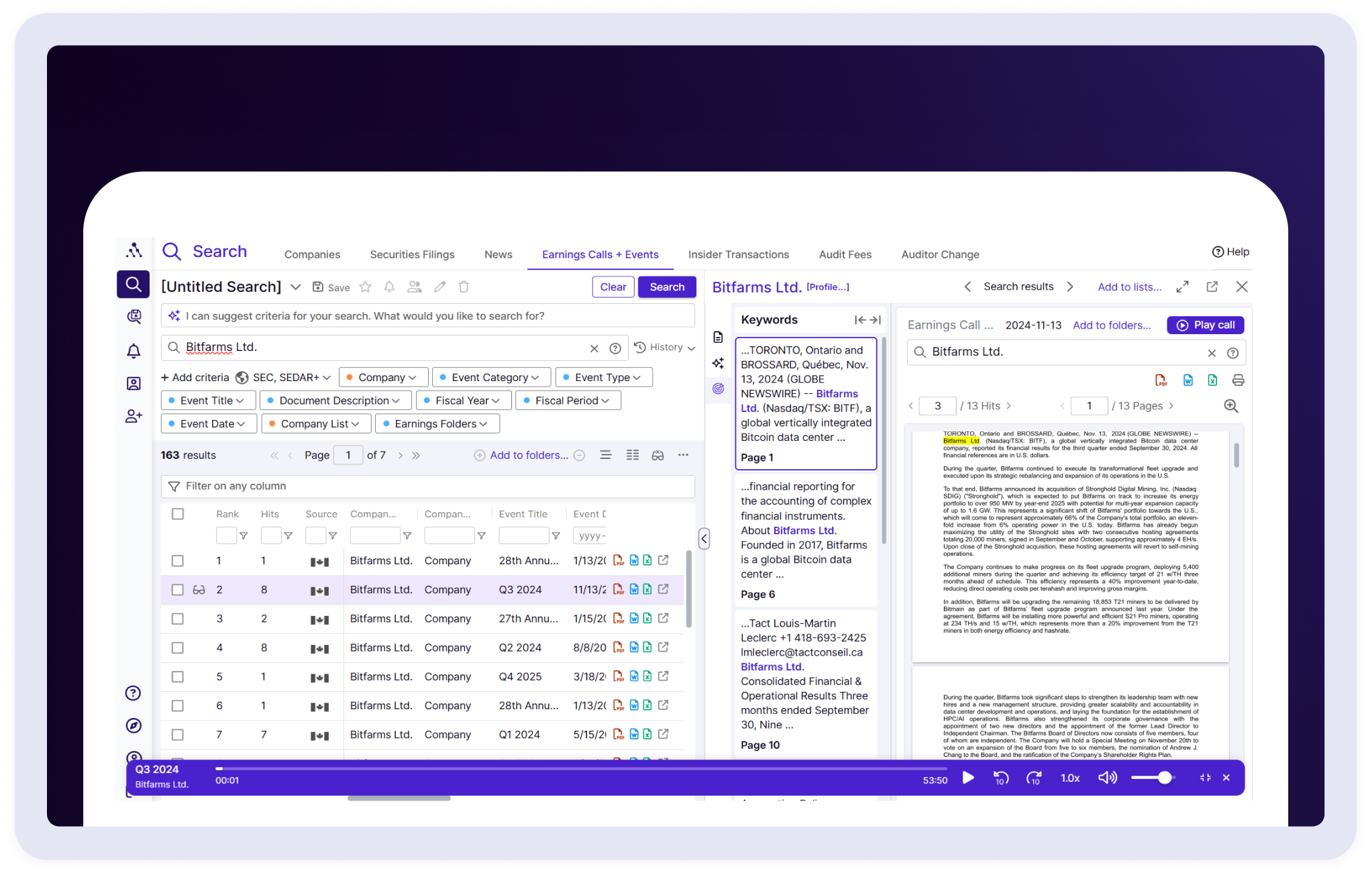
  • Pull the most recent SEC and SEDAR+ filings for your issuer or client into a single workspace.
  • Use AI assisted analysis to compare risk factor sections, MD&A narratives, and non GAAP metrics across jurisdictions.
  • Surface inconsistencies quickly so your disclosure committee can fix them before the next filing cycle or transaction.

Fewer “surprise” inconsistencies in cross border disclosure, reduced litigation and comment letter risk, and tighter board comfort around disclosure controls.

4.2 Deal prep and due diligence that is actually comprehensive

Problem: In M&A or capital markets transactions, deal teams need to triage everything material that has ever been said in public filings across both EDGAR and SEDAR+. The risk is missing a small but critical detail buried in a prior prospectus, technical report, or MD&A.

How teams use Avantis:

  • Create a deal specific universe that pulls all relevant SEC and SEDAR+ filings for the issuer, targets, and key comparables.
  • Ask natural language questions of that universe: covenants, change of control provisions, contingent liabilities, environmental disclosures, or prior guidance history.
  • Quickly find the “needle in the haystack” disclosures that might affect pricing, structure, or risk allocation.

Faster and more complete diligence, more confidence in representations and warranties, and better ability to negotiate or structure around identified risks.

4.3 Compliance monitoring and early warning for regulatory issues

Problem: Compliance and legal teams are expected to know when peers, competitors, or sector players run into regulatory trouble, receive cease trade orders, or face enforcement action in either jurisdiction.

How teams use Avantis:

  • Monitor SEC filings, SEDAR+ filings, cease trade orders, and disciplined lists in one place so that enforcement and regulatory actions show up in your regular workflow.
  • Track a curated list of issuers, funds, or insiders and see changes in their disclosure patterns or risk language over time.
  • Use findings to stress test your own policies, risk factors, and disclosure controls.

Stronger proactive compliance posture, better ability to brief senior management quickly when peers encounter issues, and fewer “we should have seen this coming” moments.

4.4 Competitive and investor relations intelligence

Problem: IR and capital markets teams need to understand how peers frame strategy, risks, ESG topics, and forward looking metrics in both US and Canadian filings. Doing this by hand is slow and makes it hard to keep materials current.

How teams use Avantis:

  • Benchmark messaging across peer groups by pulling SEC and SEDAR+ filings, along with relevant news and financial data, into a single view.
  • Analyze how competitors describe key themes such as climate risk, capital allocation, AI adoption, or regulatory change.
  • Use those insights to refine your own disclosure language and investor deck so that it resonates with global investors while remaining compliant in both markets.

Better informed messaging, stronger investor materials, and less time spent on manual peer review across multiple systems.

4.5 Board and executive ready insights from filing noise

Problem: Senior stakeholders do not want a stack of PDFs. They want a clear, contextual story: what changed, what matters, and what they should do.

How teams use Avantis:

  • Turn complex filing histories into concise, board ready summaries that bridge SEC and SEDAR+ disclosures.
  • Highlight trends in risk language, covenant disclosure, or guidance over time across both jurisdictions.
  • Package findings into memos or slide content that focus on action, not the plumbing of the filings.

Executives and directors are better informed with less internal effort, which strengthens oversight and decision making while freeing senior legal and finance leaders to focus on strategy.

Key takeaways for compliance, legal, and capital markets teams

To bring it all together:

  1. EDGAR and SEDAR+ are structurally different systems, not interchangeable sources
  2. Each reflects a different regulatory philosophy and data model. Treat them as such in your controls and workflows.
  3. Hidden differences show up in your actual work
  4. Form structure, search behavior, and how enforcement information appears in each system can change how you manage deals, disclosures, and monitoring.
  5. A platform like Avantis is valuable where it collapses that complexity into better decisions. The biggest gains are not “faster search” as a feature. They are:
    • More consistent cross border disclosure
    • More complete and efficient diligence
    • Stronger proactive compliance and early warning
    • Sharper competitive and IR storytelling
    • Clear, executive ready insights from vast filing histories

As cross border capital markets keep integrating and regulators lean on data driven oversight, the real competitive advantage is not just knowing where to click on EDGAR or SEDAR+. It is having an integrated, AI powered view of what those filings actually mean for your risk, your strategy, and your stakeholders. If you are responsible for disclosure controls, regulatory risk, or deal execution, it is worth asking a simple question:

“Do we have a unified, intelligent view of our SEC and SEDAR+ footprint, or are we still living in two different worlds?”

That answer will increasingly separate organizations that merely keep up from those that truly stay ahead.

Get Started Today

Ready to optimize your market research process?
Contact Avantis today for a personalized overview and free trial.