Disclosure is no longer just about putting numbers and legal language on the record. It is fast becoming a live data source for how markets price risk, how regulators respond and how boards make decisions. That shift is turning “disclosure intelligence” into its own discipline.
Avantis AI sits right in the middle of that shift. It provides an AI powered market intelligence platform focused on SEC and SEDAR+ filings, corporate data, insider trades, audit fees, and news so that professionals can turn sprawling public information into practical insight.
This blog looks at what disclosure intelligence really is, how it is evolving and how Avantis helps teams move from reading documents to running disclosure driven strategies.
Most teams already consume disclosures in some way. Analysts read 10-Ks and MD&A. Lawyers review material contracts. Compliance teams monitor insider trades. Investor relations tracks peer communications.
Disclosure intelligence takes all of that activity and treats it as a systematic capability. It combines:
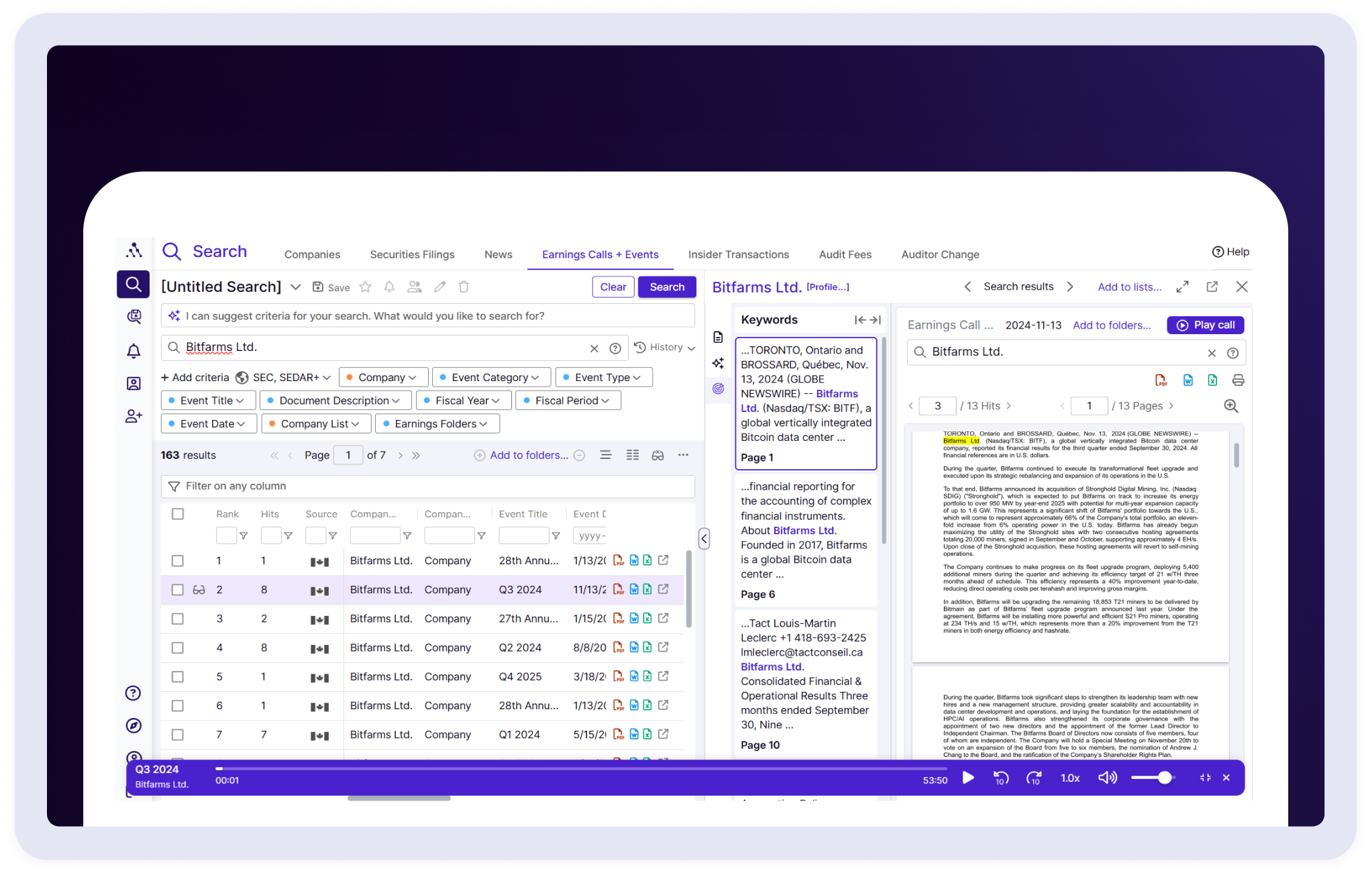
Avantis positions itself exactly in that space. The platform brings together SEC and SEDAR+ filings, corporate profiles, insider trading data, audit fees, stock prices, and news releases in one environment designed for research and monitoring.
Three trends are driving change in how organizations consume disclosure data.
1. Volume and history keep expanding
Regulatory systems such as EDGAR and SEDAR+ produce a constant stream of filings. Avantis points to coverage of filings back to 1997 for both SEC and SEDAR+, along with tens of millions of documents and more than a million filings per year. That scale makes manual document by document review unrealistic for most teams.
2. Timeliness now matters as much as accuracy
A material 8-K, a new SEDAR+ filing, or a cluster of insider trades can change an exposure profile overnight. Avantis highlights real time alerts across SEC and SEDAR filings, insider trades, and market shifts, supported by monitoring systems that notify users as soon as relevant activity occurs.
3. Context beats standalone documents
A single filing rarely tells the full story. Teams want to see how one disclosure fits into historical patterns, peer behavior, and market reaction. Avantis addresses that by combining filings with corporate and market data, stock price and charting, and corporate profiles that sit alongside the raw documents.
Together these shifts make clear that disclosure intelligence is no longer just document retrieval. It is a blend of data engineering, research workflow, and AI support.
Traditional filings tools have focused on access. You search by form type, ticker, or date and download PDFs. That is a useful starting point. It is not enough when you are handling complex portfolios, cross border exposures, or regulatory scrutiny.
Avantis sets out to close that gap with AI content analysis and natural language querying. The platform allows users to ask questions in plain language and receive fully cited responses that point back to the underlying disclosures. This helps teams move faster from “what was filed” to “what does this mean for our risk, our investment thesis, or our competitive position”.
By sitting on top of a large, unified dataset of filings, insider transactions, and market data, Avantis’s AI capabilities can operate across millions of documents rather than just within a single PDF. That is central to the future of disclosure intelligence. The value comes from patterns that appear only when you aggregate and interpret at scale.
Regulators and boards expect that material developments are identified quickly and addressed with documented actions. That is hard to do with periodic manual checks of filing sites.
Recent Avantis blogs on real time risk monitoring describe how the platform continuously tracks new disclosures and insider activity, and how alerts help compliance and risk teams see issues as they emerge instead of after the fact.
In practice this means:
That turns monitoring from a checklist into an ongoing control. In the future of disclosure intelligence, that continuous loop between data, insight, and action will be essential.
Avantis explicitly frames itself as a disclosure and investment research platform. The site highlights use cases such as equity research, risk monitoring, precedent research, competitive analysis, and regulatory research.
For investment and equity analysts, this allows teams to:
For legal and regulatory teams, the same platform supports:
The key point is that everyone looks at the same underlying disclosure universe, but with workflows designed around their specific questions.
Disclosure intelligence is especially important during high stakes transactions and risk reviews. Avantis emphasizes due diligence as a core application. The platform helps users evaluate target companies by analyzing financial statements, governance documents, and public disclosures, as well as by monitoring insider transactions and historical performance.
In a due diligence context, this can support:
For ongoing risk assessment, the combination of real time alerts, AI driven analysis, and exportable data allows risk teams to embed disclosure signals into broader risk frameworks and dashboards.
One sign of where disclosure intelligence is heading is who uses it. Avantis lists investment managers, public companies, accounting firms, law firms, consulting firms, and government and regulatory agencies among the audiences it supports.
Each of these groups approaches disclosures differently.
By providing a common platform with flexible search, analysis, and monitoring, Avantis shows how a single disclosure backbone can serve many roles without fragmenting data. That is a strong signal of where the broader market is going. As disclosure intelligence matures, it is not enough for a single analyst to run a clever query. Teams need to share findings, standardize approaches, and show their work. Avantis underscores collaboration features that let users share searches and results, manage research centrally, and give teams a unified view of what has already been analyzed. The platform is described as secure and auditable, which supports governance and regulatory expectations around how surveillance and research are conducted. At scale, that kind of collaborative layer is what turns disclosure intelligence into an organizational capability instead of a collection of individual efforts.
Putting these elements together points to a clear direction. The future of disclosure intelligence will likely be:
Avantis is already aligning its platform with these characteristics. Its focus on AI content analysis, comprehensive disclosure coverage, real time alerts, and collaborative research tools shows how one provider is helping define best practice in this emerging space. From there, the path is about turning isolated document reviews into a repeatable capability. With platforms such as Avantis, disclosure intelligence becomes less about chasing filings and more about using those filings to guide strategy, manage risk, and stay ahead of change.

Ready to optimize your market research process?
Contact Avantis today for a personalized overview and free trial.

 Get Started with Avantis for Free
88 Queens Quay West, Suite 2500, Toronto, ON, Canada M5J 0B8

(289) 803-8222
© 2026 Avantis AI Inc.