In today’s regulation-heavy Canadian business environment, effective disclosure workflows matter more than ever. Whether you are a publicly-traded company, a legal advisor, an investor, or an audit firm, managing bilingual disclosure, the English and French dimensions that define regulatory communications in Canada, is both a compliance necessity and a strategic opportunity. This blog walks through a comprehensive, bilingual disclosure workflow tailored for Canada, and shows how platforms like Avantis AI help bring clarity, efficiency and insight to the process.
Canada’s regulatory landscape places real emphasis on bilingual communication. Filings submitted via SEDAR +, for example, often require English and French versions, and many stakeholders expect disclosures that are consistent in both languages. The “workflow” of disclosure therefore is not simply about drafting and filing: it must also consider translation, parallel editing, regulatory timing, auditability, and ongoing monitoring for language-consistency.
From a strategic viewpoint, strong bilingual workflows deliver several benefits:
Given these stakes, a robust bilingual disclosure workflow should be considered a core part of a Canadian public company’s or adviser’s operations, not an afterthought.
Here’s a proposed workflow to handle bilingual disclosures efficiently and effectively:
Begin with a bilingual planning stage. Establish the disclosure event (e.g., annual report, MD&A, prospectus update), define the languages (English and French), engage translation resources, and determine the regulatory filing deadlines for both language versions. Clarify which version will be filed first and whether the other language version must immediately follow. Align internal owners: legal, investor relations, finance, translation team.
Draft the document (for many Canadian companies the English version is standard) with full disclosure-content: financials, management discussion, risk factors, auditor commentary, governance notes. At this stage pay attention to regulatory reference (e.g., Canadian securities laws), and ensure that the document is designed to allow translation without losing meaning or structure.
Once the English draft is solid, initiate translation into French. During translation keep cosmetic elements (tables, chart labels, note numbering) consistent. Key phrases (e.g., “risk factors,” “significant accounting policies”) should map clearly across languages. After translation, carry out bilingual quality control: ensure the French version reflects the meaning, structure and numeric data of the English version.
Now bring both language versions side by side and run a review: Does the French version contain every disclosure element present in English? Are tables, figures and footnotes consistent? Are references, exhibits and appendices aligned? This review may involve legal, finance and translation teams. Any discrepancies should be corrected to maintain equivalence.
Apply final formatting suitable for filing (PDF, tagged format if required), include required metadata (filing date, issuer name, language flag, page numbering), incorporate bilingual headings, and ensure any cross-references remain valid in both languages. Also ensure that submission systems (e.g., SEDAR+) accept both language versions and flag them appropriately.
After filing, monitor the submission: confirm that both language versions are accepted, and check for any regulatory acknowledgments or queries. Post-filing, set up alerts to track whether any language variants of subsequent disclosures (e.g., insider transactions, technical updates) are filed, and verify that language parity continues across future events.
Maintain both language versions in your disclosures archive. Document the translation, review, approval and submission workflows for audit purposes. Ensure governance standards cover language equality: any amendments or restatements must be issued in both languages simultaneously and tracked. This ensures you are ready for internal or external audits of your disclosure governance.
Finally, reflect on the workflow: How long did translation and review take? Were there bottlenecks? Who flagged errors? Are there repetitive issues across disclosures? Use this insight to refine your process: perhaps standardize bilingual templates, build a terminology glossary for French/English financial-regulatory terms, or invest in tools that accelerate bilingual review.
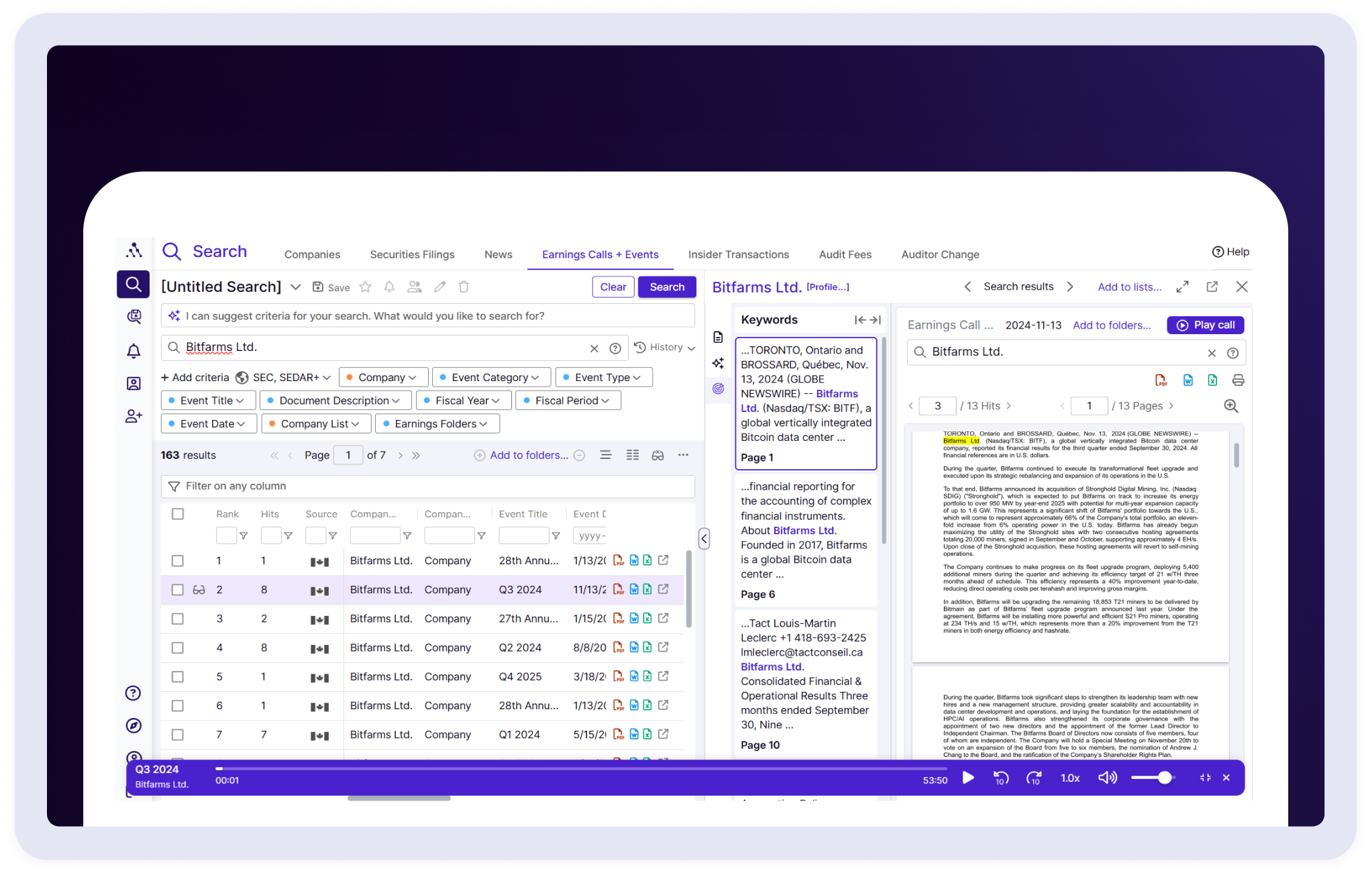
This is where Avantis comes into play. The platform offers a purpose-built solution for disclosure workflows, including bilingual contexts. For example:
By leveraging a platform like Avantis, you can reduce the time spent juggling bilingual documents, improve consistency across English and French versions, and strengthen your audit trail. You also gain a competitive advantage: being able to surface insights, compare disclosures across peer companies in both languages, and monitor updates in real time.
A bilingual disclosure workflow is no longer optional in the Canadian regulatory environment, it is fundamental to compliance, credibility and operational excellence. By structuring your workflow, planning bilingually, drafting one language, translating, aligning, submitting, monitoring, archiving and improving, you set your organization up for success. And by integrating tools like Avantis AI, you bolster your capability to handle not only the complexity of bilingual disclosure, but also the broader challenge of regulatory, financial and market-intelligence data. In short: you get a workflow that is efficient, auditable, and insight-driven. Whatever your role: issuer, legal advisor, audit firm, investor relations professional, approaching disclosure with a bilingual mindset and the right tooling means you will be better placed to meet regulatory demands, serve your stakeholders, and respond with agility in a complex market.

Ready to optimize your market research process?
Contact Avantis today for a personalized overview and free trial.

 Get Started with Avantis for Free
88 Queens Quay West, Suite 2500, Toronto, ON, Canada M5J 0B8

(289) 803-8222
© 2026 Avantis AI Inc.